Regional 9-1-1 Emergency Call Service
The Central Coast Regional District (CCRD) is working to establish 9-1-1 as a regional emergency call service. Following a feasibility study completed with MX Webb Consulting Inc. and consultation with the Nuxalk and Heiltsuk Nations, the CCRD is moving forward with the Regional 9-1-1 Emergency Call Service Establishment Bylaw No. 566, 2026.
Establishing 9-1-1 service requires the CCRD to formally establish the service by bylaw and obtain participating-area approval before the bylaw can be adopted.
On August 7, 2026, the Board considered the results of the Alternative Approval Process (AAP) previously conducted for Bylaw No. 566. The Board acknowledged that the AAP could not provide valid participating-area approval for the bylaw as drafted and directed that the AAP and elector response forms received not be relied upon for that purpose.
The Board subsequently directed that participating-area approval be obtained through assent voting, sometimes referred to as a referendum, with general voting day to be held on Saturday, October 17, 2026 in conjunction with the 2026 General Local Election.
The Board also rescinded third reading of Bylaw No. 566, amended the bylaw to reflect the new participating-area approval process, gave the amended bylaw third reading, and directed that it be submitted to the Inspector of Municipalities for approval.
Next Step: Assent Voting on October 17, 2026
Electors throughout Electoral Areas A, B, C, D and E will have the opportunity to vote directly on whether the CCRD should establish the Regional 9-1-1 Emergency Call Service.
The Board has directed that the five Electoral Areas be treated as a single voting area for the assent vote. A majority of valid votes cast across the entire proposed service area will determine the result.
The question approved by the Board is:
“Are you in favour of the Central Coast Regional District adopting ‘Regional 9-1-1 Emergency Call Service Establishment Bylaw No. 566, 2026’, that would establish a Regional 9-1-1 Emergency Call Service for Electoral Areas A, B, C, D and E?”
Additional information regarding voting locations, advance voting, mail ballot voting, elector eligibility and other voting opportunities will be published on the Elections page as the election approaches.
The CCRD will also distribute a public information brochure to deliverable mailing addresses throughout Electoral Areas A, B, C, D and E. The brochure will provide information about the proposed service, estimated costs and tax implications, the assent-voting question, elector eligibility and voting opportunities.
Reasons for Establishment
The feasibility study included extensive consultation with CCRD staff, emergency response personnel, provincial government staff and community representatives, along with a site visit and documentation review. The work identified several gaps in how emergency calling currently works across the Central Coast:
- Multiple emergency numbers. Residents currently rely on different phone numbers and different processes to reach fire, ambulance and police, depending on the department or agency involved.
- No automatic caller location. Because emergency calls are routed through the regular public phone system, call takers cannot automatically see a caller’s location or identity. This can delay how quickly a call is created and lead to responders being sent to inaccurate locations.
- No region-wide coordination. Without a formal 9-1-1 program, there is no consistent, region-wide approach to emergency call handling or service performance reporting, both of which are needed to keep the service efficient and reliable.
A formal 9-1-1 service addresses these issues by providing a single, well-known emergency number, automatic caller location information and a coordinated regional approach to emergency call handling.
A second driver is the national transition to Next Generation 9-1-1 (NG9-1-1). NG9-1-1 provides enhanced information to 9-1-1 call answer points and dispatch centres, improves information sharing between emergency response agencies, and supports new communications technologies such as real-time text messaging.
Services and Costs
The proposed service will provide NG9-1-1 primary call answer with fire dispatch, providing a consistent system for receiving and locating emergency calls and routing emergency assistance throughout the Central Coast.
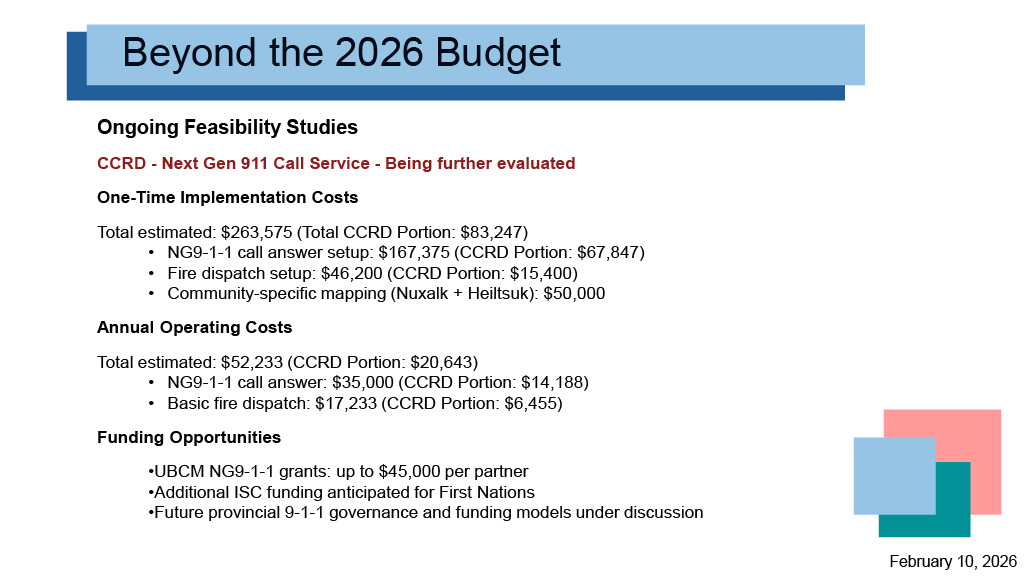
A significant portion of the one-time implementation costs may be funded through programs supporting NG9-1-1 implementation in British Columbia. The CCRD has partnered with the Heiltsuk and Nuxalk Nations and obtained a $130,000 grant to support implementation of the service.
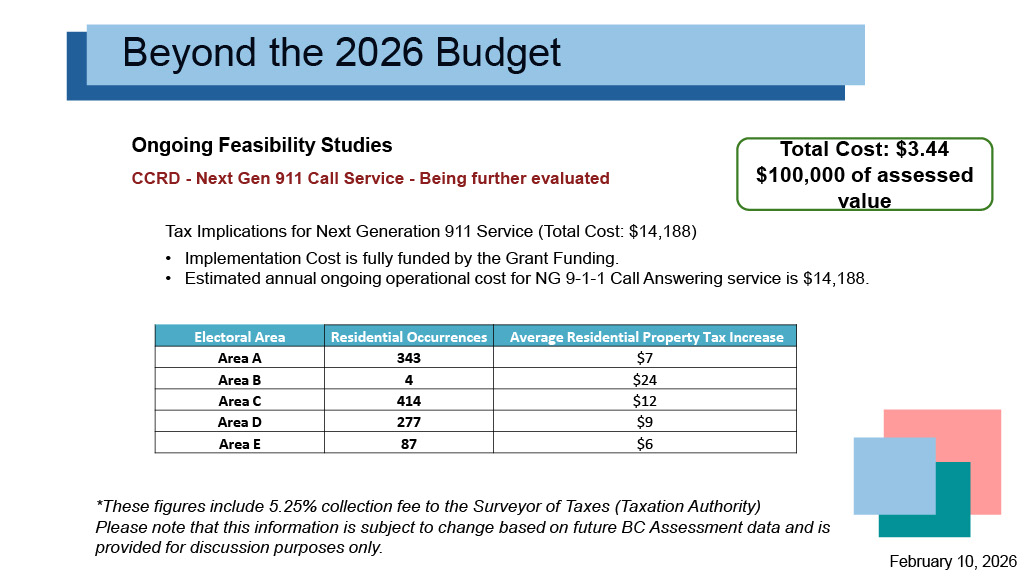
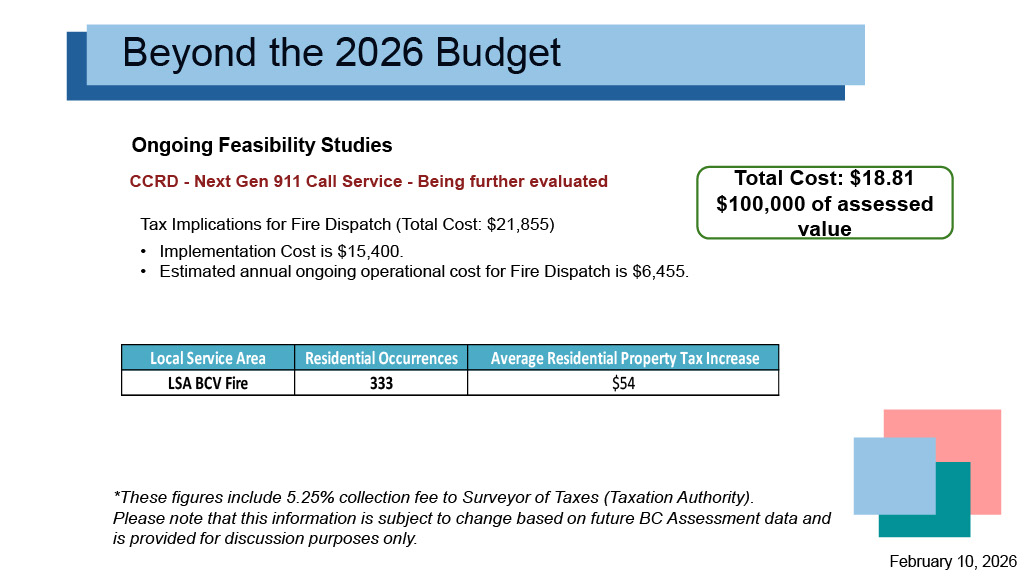
Learn more about the proposed NG9-1-1 service, including estimated costs, funding opportunities and potential property tax implications presented as part of the 2026 budget discussions in the Next Generation 9-1-1 Service Review Presentation – February 2026.
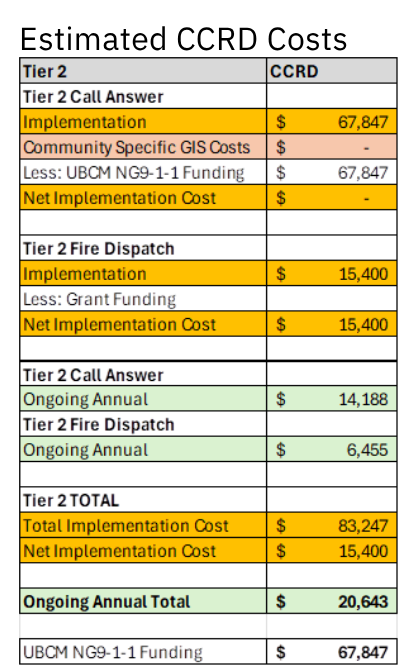
Estimated costs:
Table Summary of Costs for Tier 2 Service
Next Generation 9-1-1 Service Review Presentation February 2026
Assent Voting – Regional 9-1-1 Emergency Call Service
What is Assent Voting?
Assent voting is a direct vote of eligible electors on a proposed local government bylaw or other matter. It is sometimes commonly referred to as a referendum.
Unlike an Alternative Approval Process, where only electors opposed to a proposal submit a response form, assent voting provides every eligible elector with the opportunity to cast a YES or NO ballot.
For Bylaw No. 566, the Board has directed that participating-area approval be obtained by assent of the electors in accordance with the Local Government Act.
Why is the CCRD Proceeding to Assent Voting?
The CCRD previously conducted an Alternative Approval Process for Regional 9-1-1 Emergency Call Service Establishment Bylaw No. 566, 2026.
Following completion of that process and a subsequent review of the applicable legislation, the Board determined that the AAP could not provide valid participating-area approval for Bylaw No. 566 as it was drafted.
At its August 7, 2026 Special Board Meeting, the Board:
- received the Corporate Officer’s statement respecting the AAP;
- acknowledged that the AAP could not provide valid participating-area approval for Bylaw No. 566;
- directed that the AAP and elector response forms received not be relied upon as participating-area approval;
- abandoned the previous direction to obtain approval through an AAP;
- amended Bylaw No. 566 and gave the amended bylaw third reading;
- directed that the amended bylaw be submitted to the Inspector of Municipalities for approval; and
- directed that participating-area approval instead be obtained directly from electors through assent voting.
When Will Voting Take Place?
General Voting Day: Saturday, October 17, 2026
The assent vote will be conducted in conjunction with the 2026 General Local Election.
Advance voting, mail ballot voting and other applicable voting opportunities will also be available. Detailed information regarding voting dates, locations, hours and mail ballot procedures will be published as it becomes available.
Who Will Vote?
The assent vote applies to the entire proposed Regional 9-1-1 service area, comprising:
- Electoral Area A
- Electoral Area B
- Electoral Area C
- Electoral Area D
- Electoral Area E
The Board has authorized the entire proposed service area to be treated as one voting area. Votes cast throughout Electoral Areas A, B, C, D and E will therefore be combined when determining the result.
Eligible resident electors and eligible non-resident property electors within the voting area may vote, subject to the elector eligibility requirements of the Local Government Act.
What Will Electors Be Asked?
The Board has approved the following question:
“Are you in favour of the Central Coast Regional District adopting ‘Regional 9-1-1 Emergency Call Service Establishment Bylaw No. 566, 2026’, that would establish a Regional 9-1-1 Emergency Call Service for Electoral Areas A, B, C, D and E?”
Electors will vote either YES or NO.
If a majority of valid votes cast are in favour, participating-area approval will be obtained and Bylaw No. 566 may proceed toward adoption once all other statutory requirements have been satisfied.
If a majority of valid votes cast are opposed, participating-area approval will not be obtained and the bylaw cannot proceed to adoption through the current process.
Public Information
The CCRD will provide additional neutral public information in advance of voting day.
A public information brochure will be mailed to deliverable addresses throughout Electoral Areas A, B, C, D and E. Information will include:
- what the proposed Regional 9-1-1 Emergency Call Service would provide;
- the proposed service area;
- estimated service costs and property tax implications;
- the assent-voting question;
- elector eligibility;
- advance, general and mail ballot voting opportunities; and
- the effect of a YES or NO result.
Updated information will also be published on this webpage as the assent-voting process proceeds.
Timeline
- March 26, 2026: Bylaw No. 566 received first, second and third readings.
- June 2026: Inspector approval received for the original bylaw.
- July 30, 2026: Alternative Approval Process response deadline.
- August 7, 2026: Board received the AAP statement, determined the AAP could not provide valid participating-area approval, amended Bylaw No. 566 and directed that approval instead be obtained through assent voting.
- August 2026: Amended Bylaw No. 566 submitted to the Inspector of Municipalities for approval.
- Fall 2026: Statutory voting notices and public information distributed.
- October 17, 2026: General Voting Day for the Regional 9-1-1 assent vote, in conjunction with the 2026 General Local Election.
*Dates and voting arrangements other than General Voting Day may be updated as the election process proceeds.